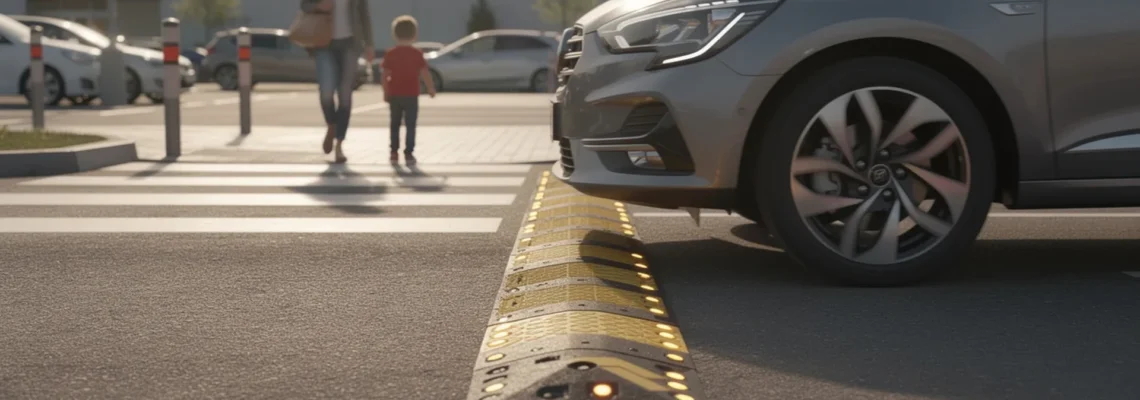
Car parks and private roads present some of the highest-risk environments for vehicle-pedestrian conflict, largely because they combine reversing manoeuvres, mixed traffic, and pedestrians moving between parked cars and building entrances. Speed bumps remain one of the most straightforward and cost-effective ways to manage this risk. By physically encouraging drivers to reduce speed, they cut down reaction times needed to avoid collisions and help create a more predictable traffic environment for everyone using the site.
This guide looks at the design standards, engineering principles, and legal considerations that apply to speed bumps on private land, along with practical guidance on installation, maintenance, and real-world applications across UK sites.
Speed bump design standards and material specifications
Not all speed bumps are built the same way, and the material used has a direct effect on performance, durability, and vehicle impact. Choosing the right specification depends on traffic volume, vehicle type, and whether the installation needs to be permanent or removable.
Tarmac and asphalt speed humps versus rubber modular ramps
Traditional tarmac or asphalt speed humps are built into the road surface itself, making them a permanent feature. They tend to be extremely durable and are commonly used on adopted roads where long-term traffic calming is required. However, once installed, they are difficult and costly to remove or reposition.
Rubber modular ramps, by contrast, are bolted onto the existing surface rather than built into it. They are quicker to install, easier to relocate if traffic patterns change, and generally less harsh on vehicle suspension. For private car parks and industrial sites where flexibility matters, modular rubber or recycled rubber ramps are often the more practical choice.
Speed cushion dimensions according to BS EN 1436 compliance
Speed cushions are segmented rather than running the full width of the road, which allows vehicles with wider axles — such as buses and emergency vehicles — to straddle the gaps and pass over with reduced impact. This makes them particularly useful on routes that need to remain accessible to larger vehicles while still slowing down standard cars.
Typical speed cushions are around 65–75mm high, sitting within the general 25mm to 100mm height range permitted for road humps in the UK. Road markings and studs associated with traffic calming installations should be applied in line with recognised road marking standards to ensure visibility and durability in all weather conditions.
Thermoplastic speed bumps for High-Traffic retail car parks
In busy retail environments, surface durability is a key concern. Thermoplastic materials are often applied to road markings and hazard indicators on and around speed bumps because they bond well to tarmac and resist wear from constant vehicle traffic. While the core body of a speed bump may be rubber, concrete, or asphalt, thermoplastic finishing helps maintain the high-visibility yellow and black markings that alert drivers to the hazard ahead, even after heavy footfall and vehicle use.
Recycled rubber speed bumps for sustainable site development
Recycled rubber speed bumps are increasingly popular for organisations with sustainability commitments. They are environmentally friendly, highly impact-resistant, and well suited to commercial settings where durability is important. Because they are modular, they can also be repositioned or reused if a site’s layout changes, reducing waste compared with permanent concrete or tarmac installations.
Traffic calming engineering principles in private road networks
Getting the engineering right is what separates an effective traffic calming scheme from one that simply frustrates drivers without improving safety. Placement, spacing, and profile all need to work together.
Optimal speed bump spacing and placement calculations
Spacing has a direct impact on how well a speed bump scheme performs. If bumps are placed too close together, drivers and residents may experience excessive discomfort, noise, and additional wear on vehicles. If they are spaced too far apart, drivers tend to accelerate between bumps, undermining the intended speed reduction.
As a general guide, speed bumps are typically positioned between 20 and 150 metres apart, with an average spacing of around 70 metres commonly used to maintain consistent low speeds. In very low-speed environments — around 5mph — spacing tends to sit toward the shorter end of that range. Precise positioning should ultimately be determined by a qualified traffic engineer, who can assess site-specific factors such as traffic flow, road layout, and safety requirements.
Gradient and profile design for 20mph zone compliance
UK guidance sets a minimum speed bump height of 25mm and a maximum of 100mm, with most installations falling between 50mm and 75mm to balance effective speed reduction against driver comfort and vehicle wear. Design standards also specify a minimum length of 900mm and a maximum gradient of 1:10, with no vertical face greater than 6mm. These parameters keep the bump predictable and visible while avoiding sudden, damaging impacts as vehicles pass over.
Speed bumps intended for public roads are generally installed only where the speed limit is 30mph or below, and they must be installed perpendicular to the road, with adequate signage and lighting to warn drivers in advance.
Sinusoidal versus Round-Top hump profiles for vehicle suspension
The shape of a speed hump affects how a vehicle’s suspension responds to it. A rounded or gradually tapered profile allows tyres and suspension components to absorb the impact more smoothly than a hump with an abrupt vertical face. This is why regulations limit the maximum vertical face height to 6mm — a sharp edge increases the risk of damage to springs, ball joints, shock absorbers, and steering alignment, particularly if a vehicle passes over at speed. Gradual profiles are generally more comfortable for passengers and reduce long-term wear on vehicles using the route regularly.
Pedestrian safety outcomes in supermarket and retail car parks
Car parks are unique in that pedestrians and vehicles frequently share the same space with minimal separation. Speed bumps play an important role in reducing the risk this creates, particularly around loading areas and pedestrian crossings.
Reducing reversing collision rates near loading bays
Loading bays are among the highest-risk zones in any retail car park, since delivery vehicles frequently reverse into position with limited visibility. Positioning speed bumps near these areas forces both delivery vehicles and passing traffic to slow down, giving drivers more time to spot pedestrians and reducing the severity of any collision that does occur. Combining speed bumps with clear road markings around loading bays further reinforces safe driving behaviour in these higher-risk zones.
Speed bump integration with zebra crossings and pedestrian refuges
Speed bumps are often used alongside pedestrian crossings to reinforce safe speeds at the point where foot traffic is heaviest. Raised tables — flat-topped humps — are particularly well suited to this purpose, as they improve pedestrian visibility and create a natural, comfortable crossing point for pedestrians while requiring vehicles to slow significantly. However, placement needs care: speed bumps should not be installed too close to a zebra-controlled crossing, as this can create confusion or reduce the effectiveness of both measures.
Visibility enhancement through reflective studs and yellow hazard markings
Visibility is critical to the safe operation of any speed bump. Most compliant products feature a yellow and black finish with reflective elements to improve visibility at night or in low light. Ensuring speed bumps are positioned under adequate lighting, with clear warning signage on the approach, helps drivers reduce speed in good time rather than braking sharply at the last moment — which itself can be a hazard.
Legal compliance and local authority regulations for private land
The rules that apply to speed bumps differ significantly depending on whether they are being installed on a public highway or on private land. Understanding this distinction is essential for site operators and estate managers.
Highways act 1980 provisions for Non-Adopted roads
Speed bumps installed on public highways must comply with national traffic calming regulations set out by the Department for Transport and enforced through local highway authorities. This typically includes requirements around height, spacing, signage, and consultation with residents and emergency services. Private roads and non-adopted estate roads are not subject to the same statutory approval process, but this does not remove the responsibility to install them safely and to a recognised standard.
Planning permission requirements for speed bump installation
For private roads, private estates, and car parks, formal permission from a local council is generally not required before installing speed bumps. That said, best practice safety standards should still be followed — including appropriate height, clear signage, and correct placement — to ensure the installation is safe and does not create an unexpected hazard for drivers unfamiliar with the site.
Insurance liability considerations for estate management companies
Even without a statutory approval requirement, estate management companies and private landowners carry liability risk if speed bumps are poorly installed, inadequately marked, or cause avoidable vehicle damage. Clearly marking speed bumps, maintaining them in good condition, and following recognised design standards all help reduce this risk and demonstrate that reasonable care has been taken to protect drivers, pedestrians, and property on site.
Installation methodology and Long-Term maintenance protocols
Correct installation and ongoing maintenance are just as important as choosing the right product. A well-specified speed bump that is poorly fitted or left to deteriorate can quickly become ineffective or even hazardous.
Surface preparation and anchoring techniques for modular ramps
Installing a modular speed bump is generally a straightforward process that can be completed in under an hour per unit. The typical approach involves marking the intended position with chalk, ensuring the bump is placed at a right angle to an imaginary line running down the centre of the road, then measuring and drilling holes for the anchoring bolts. Once the surface is cleaned of debris, the speed bump is positioned and fastened securely, with bolts tightened fully to prevent movement under vehicle load. A speed bump that shifts or lifts under traffic not only loses effectiveness but can also become a trip or damage hazard.
Seasonal wear assessment and Anti-Slip coating reapplication
Regular inspection is essential to keep speed bumps performing as intended. Weather exposure, UV degradation, and constant vehicle contact can wear down surface coatings and reflective markings over time, particularly on rubber and modular plastic products. Damaged or worn speed bumps may lose their ability to slow vehicles effectively and can themselves become a hazard if sections crack or become loose. Periodic checks — ideally tied to seasonal changes — help ensure anti-slip coatings, reflective studs, and hazard markings remain effective, and that any damaged units are repaired or replaced promptly.
Case studies of speed bump implementation across the UK
Speed bumps are used in a wide range of settings across the UK, from residential estates to multi-storey car parks and school zones, each with different priorities around vehicle type, pedestrian density, and traffic flow.
Residential estate traffic calming schemes
On residential estates, the priority is typically balancing effective speed reduction with resident comfort. Speed humps and cushions in the 50mm to 75mm range are commonly used, as this height range slows vehicles sufficiently without causing excessive discomfort for drivers and passengers. Spacing tends to follow the wider accepted guidelines, with bumps positioned to prevent vehicles from building up speed between installations while avoiding unnecessary noise and wear for nearby residents.
Multi-storey car park safety upgrades
Multi-storey car parks present specific challenges, including tight turning circles, ramps, and pedestrians moving between vehicles and stairwells or lifts. Modular rubber or PVC speed bumps are often preferred in these environments because they are quick to install, easy to maintain, and simple to reposition if traffic patterns within the car park change. Speed bumps used in car parks typically fall within the 50mm to 75mm range, appropriate for the low vehicle speeds expected in these settings.
School zone speed reduction measures
School zones represent one of the highest-priority applications for speed bumps, given the concentration of pedestrian activity at drop-off and pick-up times. Speed bumps, humps, and raised tables are commonly combined with clear signage and road markings around school entrances to reinforce lower speeds. Because school zones often see a mix of parents’ cars, buses, and pedestrians in a short space of time, careful engineering of height, spacing, and signage is particularly important to balance safety with traffic flow during peak periods.