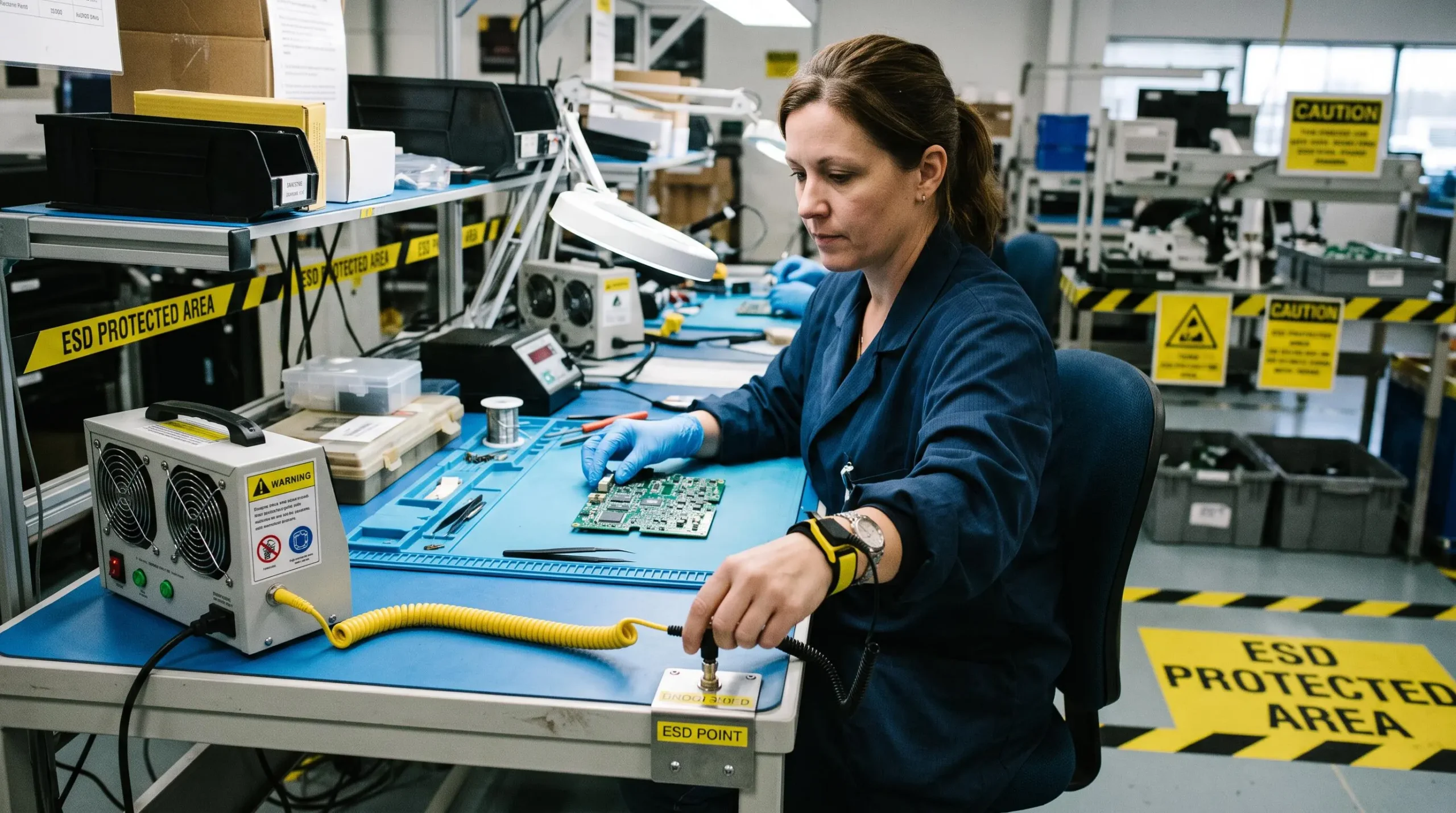
A circuit board leaves the line fully functional, passes every in-circuit and functional test, then fails three months later in the field. For quality managers in electronics assembly, this scenario is rarely random. It often traces back to an electrostatic discharge that passed through an operator, left no visible mark, and planted a weakness inside a sensitive component. Personal grounding equipment prevents these latent defects by giving the charge carried by the human body a controlled path to ground before it can discharge into the device.
Direct answer: Personal grounding equipment (wrist straps, ESD-safe footwear, heel straps, conductive garments) prevents latent component defects by continuously draining the electrostatic charge accumulated by operators, so no uncontrolled discharge can reach sensitive components during handling. Its effectiveness depends on daily verification and conformance with recognized ESD standards.
The idea to retain is simple: each piece of personal grounding equipment neutralizes a specific source of discharge carried by the operator. The sections below explain the mechanism of latent damage, then move to equipment selection by workstation and daily verification routines.
What are latent component defects and how do they originate in operators?
A latent defect is damage caused by an electrostatic discharge that does not immediately disable the component. The device still meets its electrical specifications at end-of-line testing, but an internal weakness, often a microscopic degradation of an oxide layer or a junction, has been created. Under normal operating stress, heat cycles or voltage transients, the component eventually fails. This is why a board can be shipped as fully conformant and still generate a warranty return weeks or months later.
The operator is a frequent source of this discharge. Walking across a floor, standing up from a chair or simply handling plastic packaging can charge the human body to several thousand volts without any sensation. When a charged operator touches a lead, a connector or a bare die, the stored energy flows through the component. Modern integrated circuits are increasingly sensitive, and the threshold for latent damage is often well below the threshold for catastrophic failure, which means the most dangerous events are precisely those that leave no visible trace.
Why standard tests miss latent defects: Functional and in-circuit tests confirm that the device works at a given moment. They do not reveal internal micro-damage that will shorten the component’s service life, which is exactly the signature of ESD-induced latent failure.
The cost logic is unforgiving. A field return typically combines logistics, root cause analysis, warranty replacement and, in some sectors, regulatory reporting. According to IEEE analysis of semiconductor reliability, industry estimates attribute a very significant share of semiconductor failures to ESD events occurring during manufacturing and handling. A technical brief from NASA on ESD effects in discrete components further shows that electrical overstress can seed fault conditions that cannot be detected with reliability tests, while still reducing component lifetime.
Why personal grounding is the first line of defense in PCB assembly
Surface protections such as ESD mats or ionizers are necessary but not sufficient. They address the environment around the component. The operator, by contrast, is a mobile conductor who constantly accumulates and redistributes charge. If this charge is not drained continuously, every contact with a sensitive lead is a potential discharge event. Personal grounding treats the operator as what they electrically are: a conductor that must be bonded to the same reference as the workstation.
The principle is formalized in international standards. According to the ESD Association overview of ANSI/ESD S20.20, all conductors in the environment, including personnel, must be bonded or electrically connected to a known ground. Equipping each workstation with suitable personal grounding equipment is therefore not simply an optional accessory, but a practical means of ensuring compliance with the standard in day-to-day operations.
Personal grounding also complements, rather than replaces, workstation measures. A grounded mat removes charge from objects placed on it; an ionizer neutralizes insulators that cannot be grounded; the wrist strap or ESD footwear handles the operator themselves. Removing any one of these layers reintroduces a discharge path. The practical consequence for a quality manager is clear: a program that invests in excellent mats and leaves personal grounding to improvisation will still generate latent defects.
The grounding path must also be continuous and verified. A wrist strap with a broken ground cord, a shoe sole contaminated with insulating residue, or a floor whose conductivity has degraded all break the chain silently. The operator feels nothing, works normally, and continues to inject charge into components. This is why standards require periodic verification, not simply initial installation.
Which personal grounding equipment fits each workstation?
The right equipment depends on how the operator works, not on a universal preference. Three variables matter: whether the operator is seated or mobile, whether the floor is ESD-conductive, and how long contact with sensitive devices lasts. A seated bench assembler, a mobile inspector and a packaging operator do not face the same discharge scenarios and should not receive identical equipment.
The following table summarizes the main categories and their typical use cases. Resistance ranges and compliance thresholds must always be checked against the current version of the applicable ESD standard before procurement.
| Equipment | Typical use | Key requirement |
|---|---|---|
| Wrist strap with coiled cord | Seated work at an ESD bench with a grounded mat | Continuous skin contact, verified ground path |
| ESD-safe footwear | Standing or mobile operators on an ESD-conductive floor | Floor-footwear system tested as a whole |
| Heel straps or toe straps | Short visits or mixed areas on conductive flooring | Correct contact with the sock and skin |
| ESD smock or coat | Environments with insulating clothing (synthetic fibers) | Worn closed, grounded via the operator |
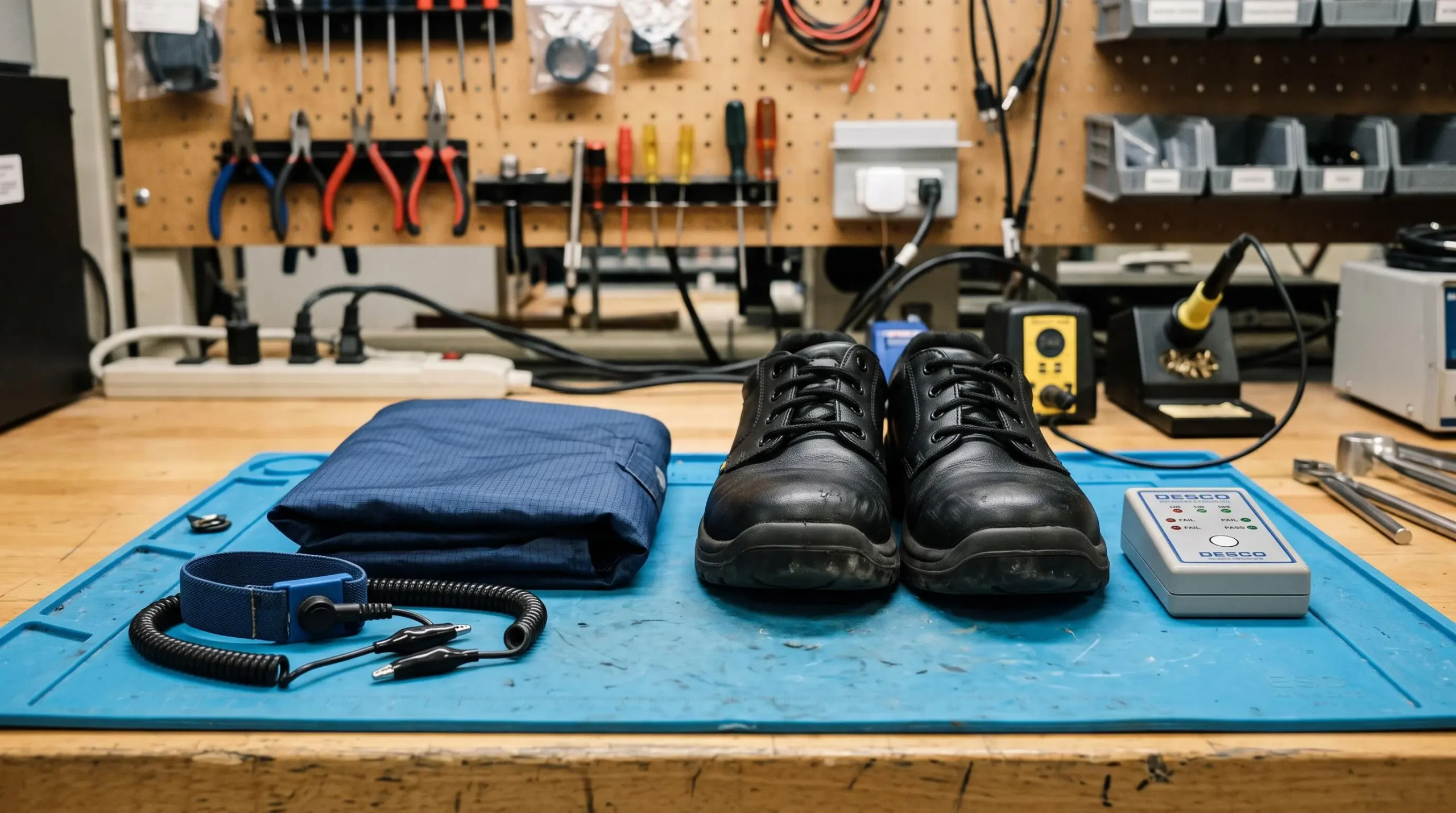
- Seated at an ESD bench:Use a wrist strap connected to the common ground point of the mat. This is the most direct and verifiable grounding path for continuous handling.
- Standing or walking on an ESD-conductive floor:Use ESD-safe footwear or heel straps. The footwear-floor system must be qualified together; neither element alone is sufficient.
- Mixed activities, short handling periods:Combine heel straps with a wrist strap at dedicated handling positions. Document which equipment applies to which task.
- Synthetic or loose clothing:Add an ESD smock worn closed. Insulating garments can carry significant charge independent of the body.
Comfort and durability are not secondary criteria. An uncomfortable wrist strap is removed; a worn heel strap loses contact; a smock left open stops working. Equipment selection should include wear testing with the operators who will actually use it, not only a compliance check on paper. For operators who move between workshops, references such as why ESD safety shoes matter explain how the footwear category combines safety and antistatic function in demanding trades.
How to implement and verify personal grounding daily?
Equipment that is not verified daily cannot be considered functional. A wrist strap cord fails from mechanical fatigue; footwear accumulates contamination; connections loosen. The purpose of daily verification is to detect these drifts before they reach the production line, not after a batch of boards has already been handled with a broken ground path.
A standard routine combines a test at the start of the shift, visual inspection, logging, and a clear rule for non-conformance. The test is performed on a dedicated bench tester that measures the resistance of the complete operator-equipment-ground loop. A pass indicates that the operator can enter the EPA (ESD Protected Area); a fail removes the operator from sensitive handling until the issue is resolved.
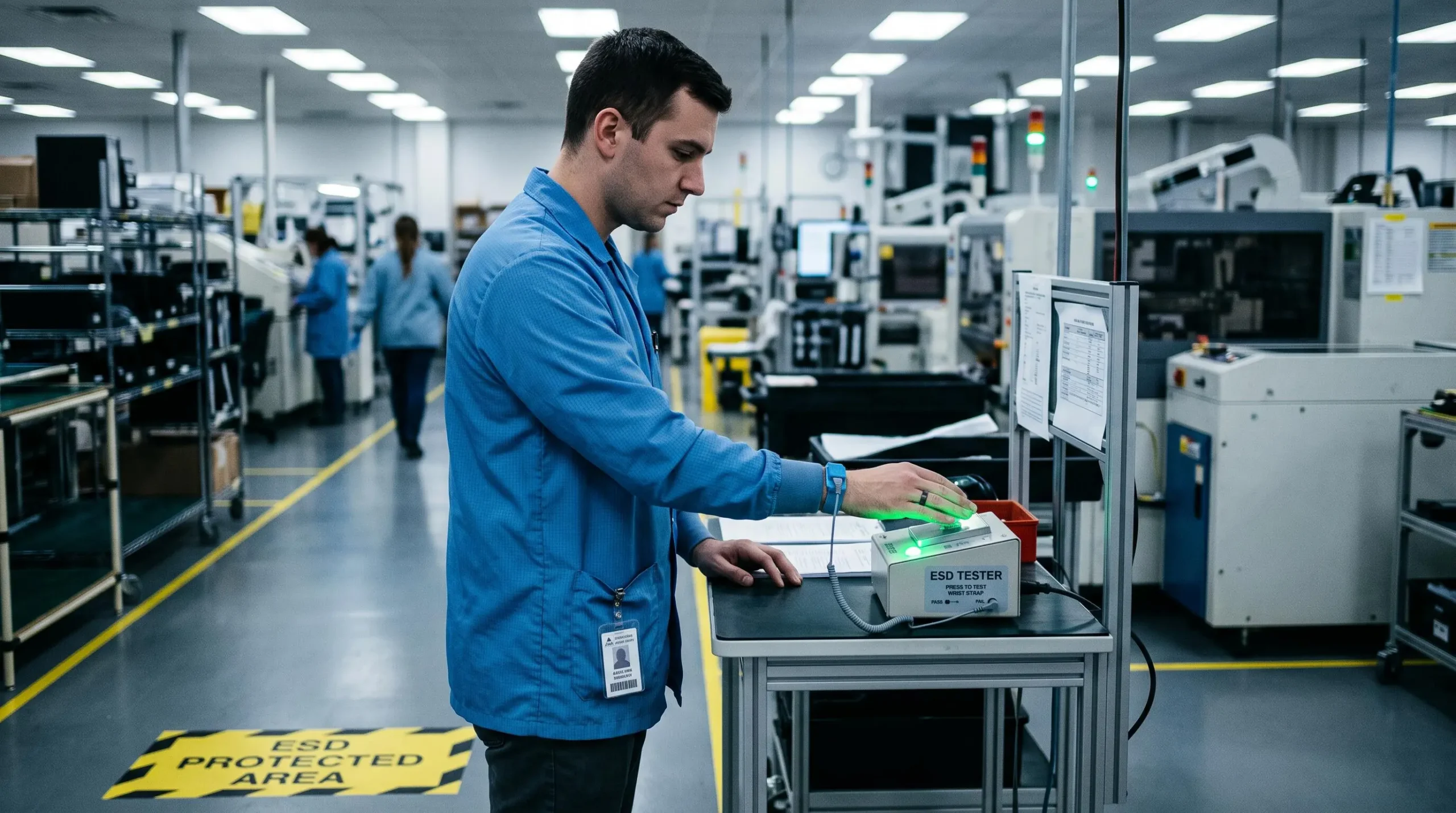
- Test the wrist strap systemPlace the strap on the wrist with full skin contact, connect the cord to the tester and record the result. Repeat for each operator before entering the EPA.
- Test footwear or heel strapsOperators wearing ESD footwear step on the foot plate of the tester and verify the pass indicator on both feet, one at a time if the device requires it.
- Visual inspectionCheck cords for cracks, banana plugs for corrosion, sole surfaces for contamination, and strap elastic for loss of elasticity.
- Log the resultRecord the operator ID, date, time and pass/fail outcome. This log supports both internal quality reviews and external audits.
- Handle non-conformanceReplace the faulty equipment immediately and re-test. Do not allow handling of sensitive components until a pass is recorded.
Frequency and documentation requirements should align with the ESD Association standards applicable to the facility. Training is equally critical: operators who understand why they test their wrist strap are far more likely to perform the check correctly than those who treat it as administrative friction. Short periodic refreshers, ideally illustrated with examples of latent failures observed in the field, keep awareness aligned with the risk.
If you need to equip or renew a workstation and want to compare suitable references for wrist straps, footwear or heel straps, you can browse the personal grounding range dedicated to electronics assembly environments.
Frequently asked questions about ESD personal grounding
Which standard governs personal grounding in electronics assembly?
ANSI/ESD S20.20, published by the ESD Association, is the reference standard for ESD control programs in electronics. It requires that all conductors in the environment, including personnel, be electrically bonded to a known ground, and specifies verification requirements for personal grounding equipment. Always check the current revision applicable to your facility.
Is personal grounding equipment really worth the cost compared with potential returns?
The equipment itself (wrist straps, heel straps, basic footwear) represents a modest recurring cost per operator. A single latent failure on a complex board can generate warranty, logistics and analysis costs that exceed the annual equipment budget for an entire workstation. The economic case rests less on the unit price than on the reduction of field returns and reputational risk.
Should an operator use a wrist strap and ESD footwear at the same time?
Yes, when the workstation and activity justify it. A seated operator who occasionally stands, or a technician who moves between benches, benefits from both. The two systems are complementary: the wrist strap guarantees continuous grounding at the bench, the footwear maintains it while moving on a conductive floor.
How do I know when to replace a wrist strap or ESD shoes?
Replace a wrist strap when the daily test fails, when the elastic loses tension, when the cord shows visible wear or when skin contact can no longer be guaranteed. Replace ESD footwear when the tester returns a fail that is not resolved by cleaning the soles, or when the manufacturer’s wear indicators are reached. Documented test failures are the primary trigger.
Can an operator damage a component without touching it?
Yes. A charged body can induce a field strong enough to affect nearby sensitive devices, and discharges can occur through tools, tweezers or packaging before the operator makes direct contact. This is precisely why continuous grounding, rather than momentary contact with a grounded surface, is required.
Latent ESD defects do not announce themselves on the test bench; they appear in the field, long after the responsible event. Equipping each workstation with personal grounding suited to the operator’s activity, verifying it every day and logging the results is the most direct way to reduce this hidden failure mode. The next practical step for a quality manager is usually to audit the current grounding equipment per workstation type, confirm that a daily test routine exists and is actually followed, and align equipment specifications with the current ESD standard in force at the facility.